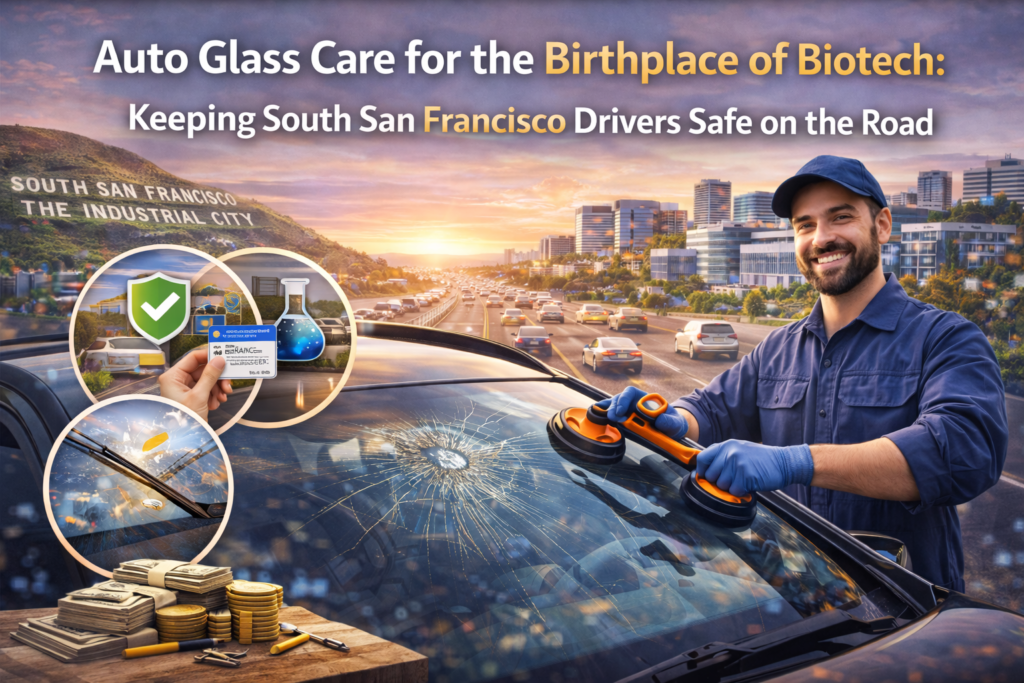
South San Francisco occupies a unique position in the Bay Area landscape. Known worldwide as the birthplace of biotechnology since Genentech’s founding in 1976, this city of innovators and scientists has evolved into one of the largest biotech clusters on the planet. With over 250 biotech companies and 12 million square feet of dedicated life sciences space, the city attracts some of the brightest minds in medicine and research. But for the tens of thousands of professionals who commute daily along Highway 101, navigate to San Francisco International Airport, or travel between research facilities, one thing remains constant: the critical importance of maintaining safe, reliable vehicles—starting with the glass that protects them.
For drivers in South San Francisco, auto glass isn’t just about aesthetics or comfort. It’s a safety essential that deserves the same attention to detail that characterizes the city’s world-renowned research community.
The Unique Driving Environment of South San Francisco
South San Francisco’s geography and infrastructure create driving conditions that place particular demands on auto glass. Situated at the southern base of San Bruno Mountain, the city serves as a critical junction between San Francisco to the north and Silicon Valley to the south. Highway 101 runs directly through the city, carrying hundreds of thousands of vehicles daily—including the heavy truck traffic that supplies the region’s construction projects and businesses.
The proximity to SFO adds another dimension. Airport-adjacent areas experience constant vehicle movement: rental car returns, ride-share pickups, employee commutes, and cargo transport. This density of traffic increases the likelihood of road debris impacts that can chip or crack windshields. A single piece of gravel kicked up by a delivery truck can turn an ordinary commute into an unexpected expense—or worse, a safety hazard.
The marine influence from San Francisco Bay creates additional challenges. Morning fog is common, and the salt air that drifts inland can accelerate wear on vehicle components, including the seals around auto glass. Temperature fluctuations between cool, foggy mornings and warm afternoons stress glass, potentially causing small chips to spread into larger cracks that require full replacement.
Why Auto Glass Matters for Safety-Conscious Professionals
The life sciences professionals who make South San Francisco their workplace understand risk assessment better than most. They know that small vulnerabilities can have significant consequences. The same principle applies to auto glass.
Modern windshields are engineered as structural safety components. In a collision, the windshield helps maintain the vehicle’s structural integrity, particularly during rollovers. It provides the reaction surface that allows passenger-side airbags to deploy correctly. A windshield compromised by cracks or improper installation cannot perform these functions reliably, potentially transforming survivable accidents into tragedies.
Visibility represents another critical safety factor. Even minor damage can create glare, especially during the low-angle sunlight common during morning and evening commutes along the Peninsula. For drivers navigating the heavy traffic between South San Francisco and employment centers throughout the Bay Area, any reduction in visibility increases risk.
Advanced Driver Assistance Systems (ADAS) add complexity for owners of newer vehicles. Cameras and sensors mounted on windshields support features like automatic emergency braking, lane departure warnings, and adaptive cruise control. When windshields are replaced, these systems require professional recalibration to function correctly—a specialized service that not all providers offer.
Understanding When Repair Beats Replacement
Not every instance of glass damage requires full replacement. Understanding the difference helps vehicle owners make informed decisions that balance safety with cost-effectiveness.
Small chips—typically those smaller than a quarter—can often be repaired rather than replaced. Professional repair involves injecting specialized resin into the damaged area, then curing it with UV light to restore both structural integrity and optical clarity. When performed promptly, before damage spreads, repairs cost significantly less than replacement while maintaining safety standards.
The key word is “promptly.” Temperature changes, road vibration, and even the pressure changes from closing doors can cause small chips to propagate into larger cracks. What could have been a quick, affordable repair becomes a full windshield replacement simply because the driver waited too long to address it.
Replacement becomes necessary when damage is too extensive for effective repair, when cracks extend to the glass edge, or when damage falls within the driver’s critical viewing area where even properly repaired glass might create distortion. Damage to the inner layer of laminated windshield glass also requires replacement rather than repair.
Working with a qualified auto glass shop South San Francisco professionals trust ensures that these assessments are made correctly. Reputable providers recommend repair when appropriate rather than defaulting to more expensive replacement, and they explain their reasoning so vehicle owners can make informed decisions.
The Convenience Factor: Mobile Auto Glass Service
For busy professionals in South San Francisco’s biotech corridor, time is perhaps the scarcest resource. Between demanding research schedules, meetings, and the logistics of Bay Area commuting, finding time to sit in a repair shop waiting room can feel impossible.
Mobile auto glass service addresses this challenge directly. Rather than requiring vehicle owners to visit a shop, mobile technicians bring their equipment to the customer’s location—whether that’s a biotech campus parking lot, a home driveway, or even an airport parking structure. The work is completed on-site, and for repairs, vehicles are typically ready to drive immediately. Replacements require curing time for adhesives before driving, but that waiting period can often be spent productively at work rather than in a waiting room.
Mobile service also solves the safety dilemma faced by drivers whose damage makes driving hazardous. Rather than risking further damage or safety incidents by driving to a shop, customers can have technicians come to them.
Selecting Quality Over Convenience Alone
While convenience matters, it shouldn’t be the only factor in selecting an auto glass provider. Quality differences between providers can significantly impact both safety and long-term value.
Glass quality varies considerably. OEM (Original Equipment Manufacturer) glass matches the specifications of glass installed when vehicles were built. Aftermarket alternatives may fit correctly but can differ in thickness, tint, or optical clarity. For vehicles equipped with ADAS features, OEM-equivalent glass is often essential for proper system function after recalibration.
Adhesive quality directly affects safety. Premium automotive adhesives, properly applied according to manufacturer specifications, create bonds strong enough to maintain structural integrity during collisions. Inferior adhesives or improper application techniques can result in windshields that fail when they’re needed most.
Installation technique matters as well. Proper preparation of bonding surfaces, correct adhesive application, and appropriate curing times all influence the final result. Rushed installations or shortcuts may look fine initially but can lead to leaks, wind noise, or—most critically—safety failures.
Warranty coverage provides important protection and often signals provider confidence in their work. Quality providers stand behind both materials and workmanship with meaningful warranties. Understanding coverage terms before authorizing work helps protect your investment.
Insurance and Cost Considerations
Many comprehensive auto insurance policies cover glass repair and replacement, often with no deductible for repairs and reduced deductibles for replacement. California law prohibits insurers from raising premiums solely because policyholders file glass claims, removing the financial disincentive that might otherwise discourage drivers from addressing damage promptly.
Quality auto glass providers typically handle insurance claims directly, managing paperwork and communication with insurers so vehicle owners don’t have to. This service adds convenience while ensuring claims are processed correctly.
Protecting Your Investment and Your Safety
For South San Francisco’s community of scientists, researchers, and professionals, vehicles represent both significant investments and essential daily tools. The same analytical thinking that drives breakthrough discoveries in biotechnology can be applied to vehicle maintenance: identify risks early, address problems promptly, and partner with qualified professionals who share your commitment to quality.
Your windshield does more than keep wind and rain out of your vehicle. It protects you. It enables the safety systems designed to prevent accidents and minimize injuries. It deserves the same attention to quality that you bring to your professional work. In the birthplace of biotechnology—where innovation and precision define the community—maintaining that standard extends to every aspect of life, including the vehicles that carry you safely through each day.