Introduction: The Rise of Identity in the Digital Age
In a world increasingly governed by digital access and sensitive data, the question of “who you are” has become the cornerstone of security and operational efficiency. Traditional keys, access cards, and passwords are no longer sufficient; they can be lost, stolen, shared, or forgotten. This vulnerability has propelled biometric authentication from a futuristic concept to a present-day necessity. Among all biometric modalities, the biometric fingerprint scanner stands out as the most widely adopted, trusted, and versatile solution for businesses worldwide.
The global biometric system market, valued at over $53 billion, is projected to surge past $95 billion by 2030, driven by demand across banking, healthcare, government, and corporate security. This explosive growth underscores a fundamental shift: organizations are recognizing that fingerprint technology is not merely a security upgrade but a strategic investment in streamlining processes, enhancing accountability, and building a foundation of trust. This guide will demystify biometric fingerprint devices, explore their transformative applications, and illustrate why partnering with an expert integrator like The NextGen Technologies is crucial for unlocking their full potential.
Biometric Finger Print Scanner: The Engine of Secure Authentication
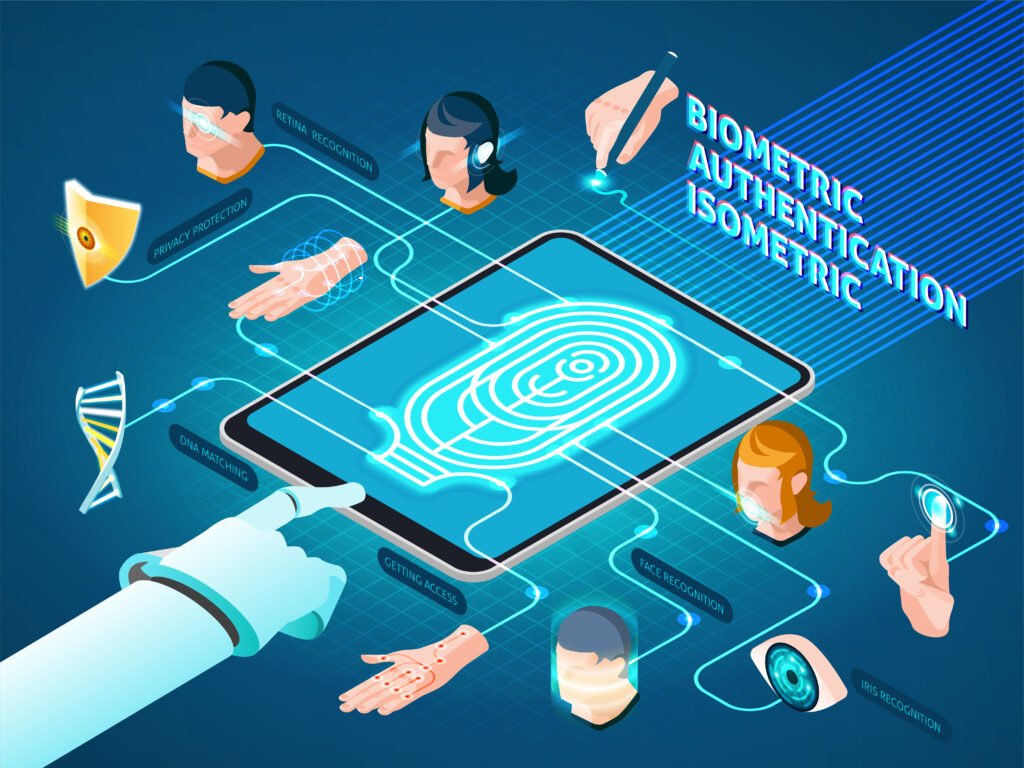
At its core, a biometric fingerprint scanner is a device designed to capture a high-resolution image of a fingerprint pattern—the unique ridges and valleys on a person’s finger—and convert it into a secure digital template for comparison. This process moves beyond simple pattern matching; it involves sophisticated algorithms that analyze minutiae points (where ridge lines end or split), creating a mathematical representation that is nearly impossible to reverse-engineer.
How It Works: From Finger to Digital Key
The journey from a physical fingerprint to a digital key involves several seamless steps:
- Image Capture: The user places their finger on the scanner’s platen. Depending on the technology (optical or capacitive), the device either captures a light-based image or measures electrical impulses from the ridge pattern.
- Template Creation: The scanner’s software processes the raw image, identifying and mapping the unique minutiae points. This data is encrypted and stored as a compact digital template—not the actual fingerprint image—ensuring user privacy.
- Matching & Authentication: During subsequent access attempts, a new scan is taken and converted into a template. This new template is instantly compared against the stored version. A match grants access; a mismatch denies it. Advanced systems can perform 1:N identification (finding one person in a database of thousands) or 1:1 verification (confirming a claimed identity).
Types of Fingerprint Scanners: Choosing the Right Technology
Not all scanners are created equal. The choice between technologies depends on the use case, environment, and required security level. The table below compares the two primary types and highlights specialized variants:
Biometric Finger Print Device: Applications Transforming Industries
A biometric fingerprint device is more than just hardware; it is the physical endpoint of an integrated security and identity management system. When deployed strategically, these devices solve critical challenges across sectors:
- Corporate Security & Access Control: Replace keycards with fingerprint readers for door access, server rooms, and restricted areas. This eliminates the cost of replacing lost cards and provides an incontrovertible audit trail of who accessed where and when. Companies like ASSA ABLOY integrate biometrics directly into advanced access control ecosystems.
- Time, Attendance, and Workforce Management: Eliminate “buddy punching” and time theft with fingerprint-based clock-in systems. This ensures accurate payroll processing, simplifies compliance, and provides clear data on workforce productivity. Standalone terminals or devices integrated with existing HR platforms make this a seamless upgrade.
- Government & Law Enforcement: From issuing national IDs and passports to criminal background checks and border management, high-resolution ten-print scanners are indispensable. Agencies require FBI-certified devices (like those from Integrated Biometrics and Mantra) that meet strict image quality standards (FAP10, FAP20, FAP30) for global interoperability and forensic accuracy.
- Financial Services & Banking: Secure customer authentication for ATM access, mobile banking logins, and in-branch transactions. Fingerprint biometrics add a powerful layer of security that is far more reliable than PINs or passwords, significantly reducing fraud risk. Leaders like IDEMIA provide specialized solutions for the financial sector.
The benefits are universal: enhanced security, unparalleled convenience for users, operational efficiency gains, and a strong audit trail for compliance.
Navigating the Market: Key Considerations and The NextGen Technologies Advantage
With a market populated by global giants like Thales, IDEMIA, and NEC, as well as specialized manufacturers, choosing the right solution can be daunting. Success hinges on more than just purchasing a device; it requires a holistic approach.
Critical Implementation Factors:
- Accuracy & Certification: For high-stakes applications, seek devices with FBI PIV certification or compliance with FAP standards, which guarantee image quality and liveness detection capabilities to prevent spoofing.
- Software & Integration: The hardware is only as good as the software that drives it. Ensure the solution includes a robust SDK (Software Development Kit) and can integrate seamlessly with your existing access control, HR, or identity management platforms.
- Durability & Environment: Consider where the device will be used. Does it need an IP54 or IP65 rating for dust/water resistance? Will it be used indoors or in harsh field conditions? Optical sensors often offer greater durability for high-traffic areas.
- Privacy & Data Security: A reputable provider will ensure biometric templates are encrypted and stored securely, often locally on the device or in a highly secure central database, complying with relevant data protection regulations.
Why Partner with The NextGen Technologies?
This is where The NextGen Technologies separates itself as a top-tier partner. We are not merely hardware resellers; we are solution architects who empower businesses with innovative, scalable IT systems.
- Strategic Consultation: We begin by understanding your unique workflow, security challenges, and growth objectives. We help you navigate the complex landscape to select the perfect biometric technology—whether it’s a simple USB login scanner or a multi-modal system combining fingerprint, face, and card access.
- Seamless Integration & Deployment: Our expertise ensures your new biometric devices work in perfect harmony with your existing IT infrastructure. We handle the entire process, from network configuration to software integration, ensuring a smooth transition with minimal disruption.
- Ongoing Support & Future-Proofing: Technology evolves rapidly. We provide dedicated support and proactively advise on upgrades or expansions, ensuring your investment continues to deliver value and remains secure against emerging threats. Our partnerships with leading technology firms allow us to deliver cutting-edge, supported solutions.
For businesses looking to harness the power of biometrics, The NextGen Technologies provides the essential bridge between advanced technology and tangible business results—enhanced security, streamlined operations, and a trusted environment for employees and customers alike.
Conclusion
The transition to biometric fingerprint technology is an irreversible trend, driven by the critical need for security that is both robust and user-friendly. From safeguarding physical premises and digital assets to streamlining administrative processes and enabling new, secure services, fingerprint scanners offer a proven and powerful solution.
Investing in this technology is a strategic decision that goes beyond purchasing hardware. It requires careful planning, expert integration, and a partnership with a provider who understands your long-term goals. By choosing a trusted advisor like The NextGen Technologies, you can confidently implement a biometric system that not only protects your assets today but also scales to meet the challenges of tomorrow, turning the unique identity of your people into the most reliable key you will ever own.
Frequently Asked Questions (FAQs)
1. Are fingerprint scanners hygienic and safe to use by many people?
Yes. Modern scanners are designed with public health in mind. The scanning surface is typically made of durable, scratch-resistant material that can be easily cleaned with disinfectant wipes. Furthermore, the technology is contact-based but does not require deep pressure, and no personal data is left on the sensor after scanning.
2. Can fingerprint scanners be fooled by fake fingerprints or photos?
Basic, low-quality optical scanners could potentially be spoofed with a high-resolution image or a gummy mold. However, professional-grade devices used in security applications feature liveness detection. This technology can detect the presence of actual human skin through pulse, temperature, or electrical conductivity, making spoofing extremely difficult. For maximum security, specify devices with this feature.
3. What if an employee has a cut, worn-out, or damaged fingerprint? Will they be locked out?
Advanced systems address this common concern in two ways. First, during enrollment, users often register multiple fingers (e.g., both index fingers). If one finger is injured, they can use another. Second, high-quality algorithms and sensors (like capacitive ones) are designed to read below the surface skin layer and can often successfully authenticate even with minor surface damage.
4. Where is my fingerprint data stored, and is it secure?
In secure systems, the actual fingerprint image is never stored. Instead, the scanner creates an encrypted mathematical template—a string of data representing the unique features. This template is what is stored, either locally on the device or in a secure central database. It cannot be reverse-engineered to recreate a fingerprint image, protecting user privacy.
5. How difficult and costly is it to implement a fingerprint system across our company?
Implementation complexity and cost vary based on scale and existing infrastructure. A basic time-and-attendance system for a small office can be straightforward and cost-effective. A full-scale, integrated access control system for a large facility is more involved. Partnering with an expert like The NextGen Technologies ensures an accurate assessment, seamless integration to minimize disruption, and a clear understanding of the total cost of ownership, which is often offset by savings from increased security and efficiency.